

If you are searching for AI efficiency for New Jersey businesses, you are not looking for hype. You are looking for practical ways to respond faster, book more appointments, reduce no-shows, follow up without dropping leads, and stop wasting hours on repetitive admin.
That is exactly where AI is delivering results for SMEs in New Jersey and across the wider USA. Not as a “big enterprise transformation”. As a set of small, measurable improvements across the customer journey.
Recent U.S. Chamber of Commerce reporting indicates that the majority of small businesses are embracing AI, and that generative AI usage has risen sharply year over year. (uschamber.com)
Below is the Motion Monsters take: a customer-facing efficiency playbook, with clear examples by industry, a grounded implementation approach, and how motion design and animation make the whole system work harder.
What “Efficiency” Really Means for New Jersey SMEs
For most small businesses, efficiency is not a KPI dashboard. It is simple:
Customers get answers quickly.
Customers can book without friction.
Follow-ups happen automatically and consistently.
Your team spends less time on repetitive admin.
You can see what is working without digging through 12 different tools.
New Jersey adds a few real-world pressures:
Dense competition corridors and high customer expectations, especially in North Jersey.
A market shaped by proximity to NYC and Philly standards for speed and service.
High operational costs where wasted time is expensive.
Nationally, the “efficiency definition” is largely consistent. The difference is usually how intense the competition is in your local area and how quickly customers move on if they do not get a fast response.
The Customer-facing Areas Where AI Improves Efficiency Fastest
If you want quick wins, start where customers feel it immediately. These are the areas most SMEs can improve without rebuilding everything.
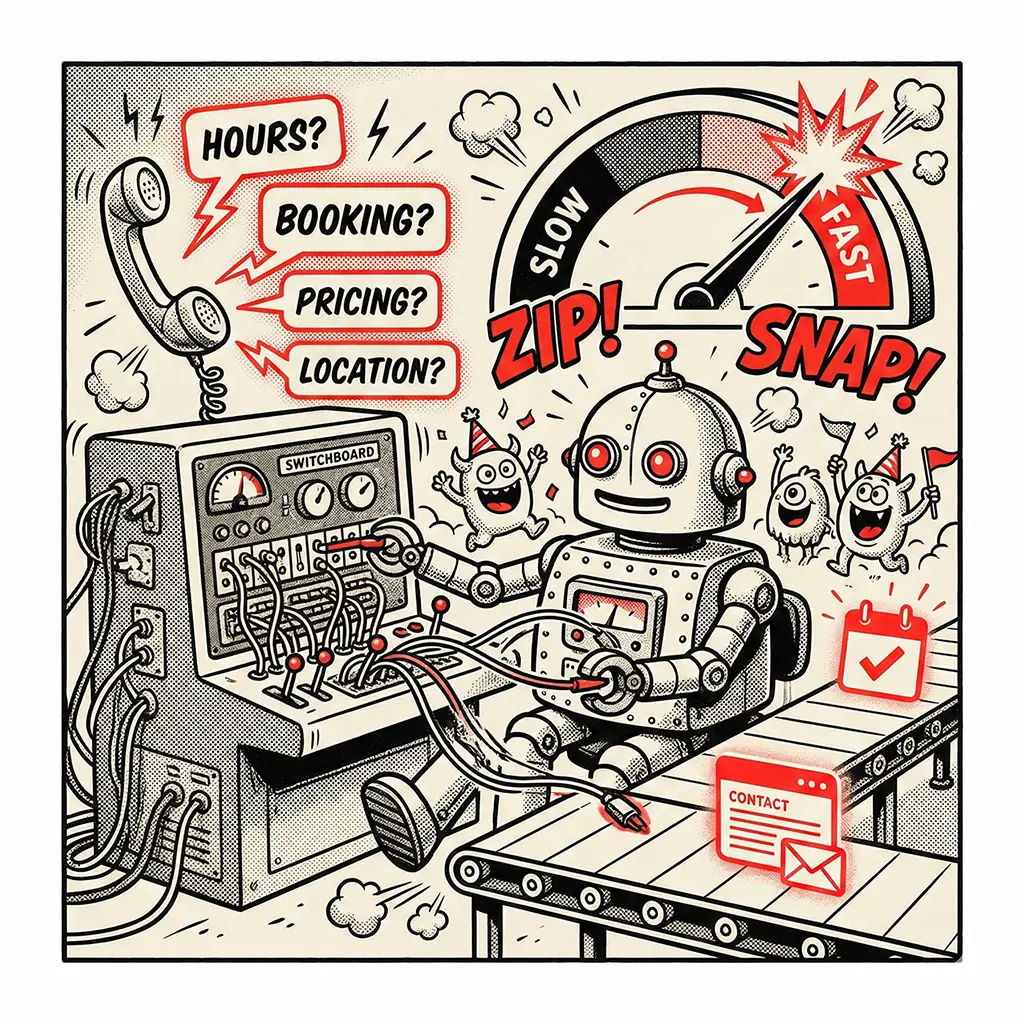
1) 24/7 Customer Response without Hiring a Night Shift
A well-configured chatbot or conversational assistant can:
Answer FAQs (hours, location, availability, service areas).
Provide basic pricing guidance (clear ranges, not invented promises).
Ask qualifying intake questions.
Send customers to booking or the right contact route.
Capture lead details and pass them into your CRM or inbox.
What you get is not “automation for the sake of it”. You get fewer missed leads, faster time-to-first-response, and less staff time spent answering the same questions repeatedly.
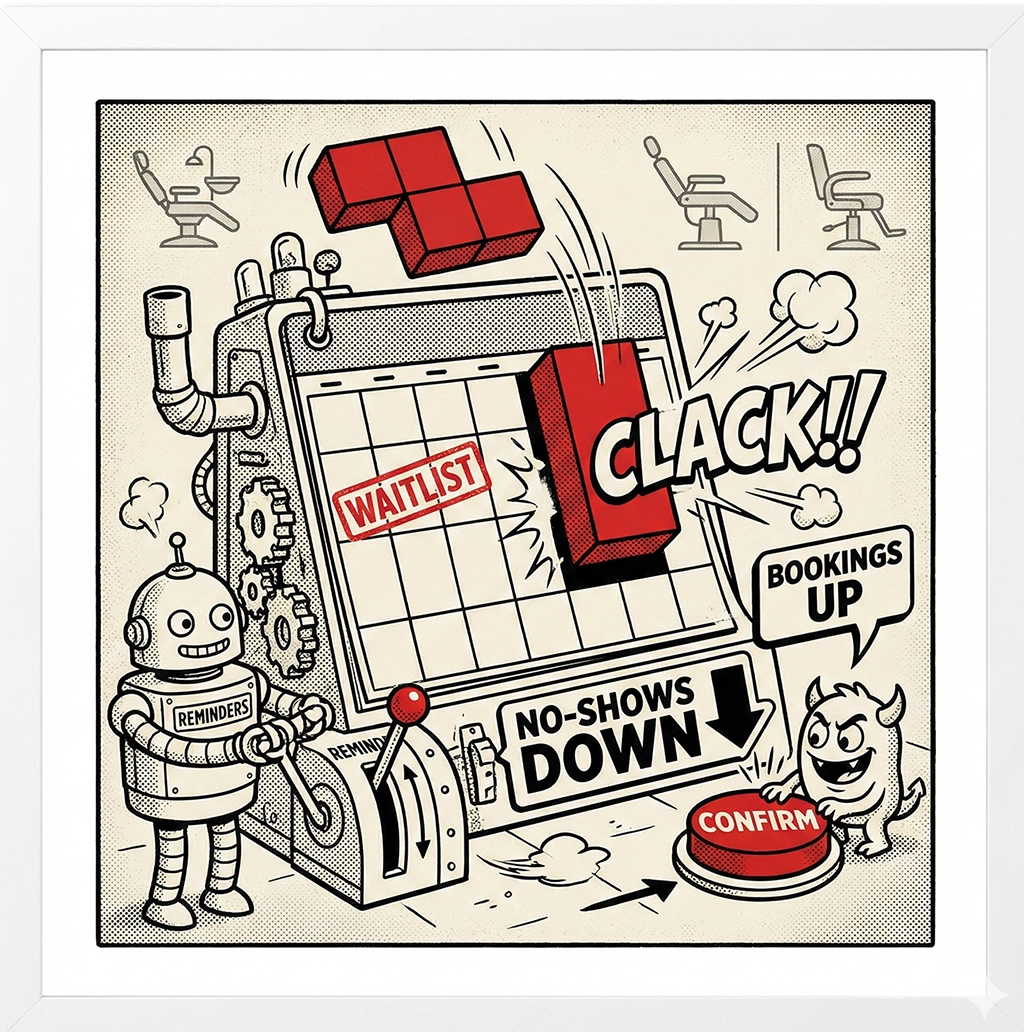
2) Faster Bookings and Fewer No-shows
Scheduling is where SMEs often bleed margin, especially for dentists, clinics, salons, and service providers.
AI-enabled booking and messaging can:
Offer appointment slots automatically.
Confirm attendance with one-tap replies.
Make rescheduling easy, which reduces no-shows.
Fill cancellations via waitlists.
Trigger reminders at the right times, not just “24 hours before”.
If you are in New Jersey healthcare, dental, or personal services, this is usually one of the quickest ROI moves because capacity is fixed. A missed appointment cannot be “re-sold” later.
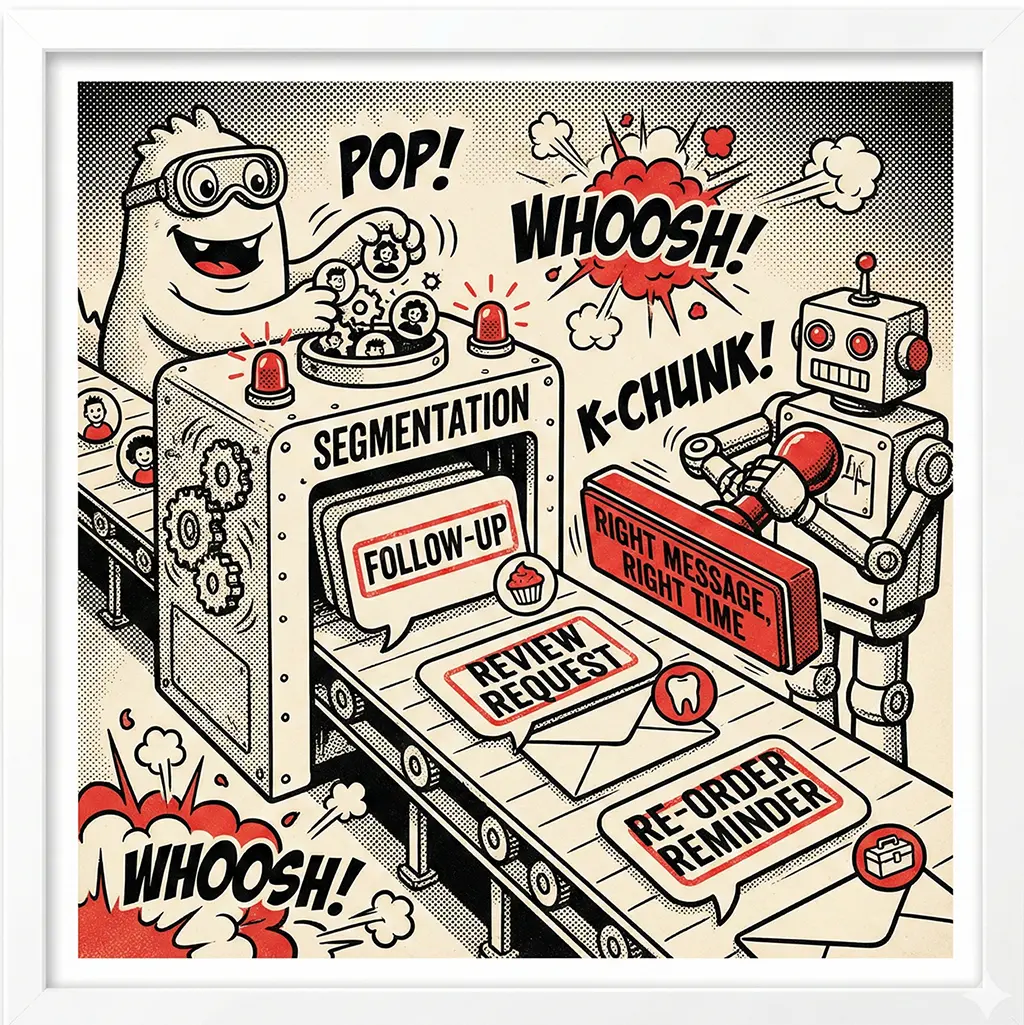
3) Personalisation without a Marketing Department
AI makes segmentation and timing easier, even for tiny teams:
Bakery: “Friday morning regulars” get weekend bundle offers.
Dentist: automated reminders for hygiene recalls at 6 months.
Contractor: follow-up sequences after quotes, with proof and next steps.
Retail: replenishment reminders and product recommendations.
This is not about creepy targeting. It is about being relevant and consistent.
4) Content that Keeps Up with the Business
Generative AI is a speed tool for content:
Draft email campaigns and variations.
Draft ad copy for testing.
Create first-pass landing page copy.
Create response templates for common questions.
Important: you still need a human editor. AI can be fast and wrong at the same time. You use it to draft, then you verify facts, tone, and claims before anything goes live.
New Jersey Use Cases That Feel Real (And Why They Work Nationally Too)
Here are practical, customer-facing stacks SMEs are using. New Jersey examples first, then how it generalises across the U.S.
Dental Practice (Newark, Edison, Morristown)
Customer-facing efficiency stack:
Website chatbot answers insurance, hours, services, and booking steps.
Automated reminders with confirm and reschedule buttons.
Post-visit follow-ups (care instructions, review prompts, next appointment).
AI-assisted call summaries so staff stop retyping notes.
Why it works in NJ:
Competitive market, high patient choice.
Speed and clarity win, especially for new patient conversion.
Why it works nationally:
The same mechanics apply everywhere, especially where no-shows are costly.
Bakery or Café (Jersey City, Asbury Park, Hoboken)
Customer-facing efficiency stack:
Pre-order assistant collects details for custom orders.
Forecasting helps reduce waste and stockouts.
Pickup messages and status updates reduce customer calls.
Weekly promo drafting to keep marketing consistent.
Why it works in NJ:
High footfall areas need speed and reduced queue friction.
Waste reduction matters when ingredient costs are volatile.
Why it works nationally:
Food service is a margin game everywhere. Demand forecasting and faster service help.
Home Services (Plumber, HVAC, Electrical)
Customer-facing efficiency stack:
AI intake form that asks the right questions upfront.
Auto-routing and scheduling for faster response windows.
“On the way” messaging reduces inbound calls.
Follow-up sequences to drive reviews and repeat work.
Why it works in NJ:
Customers expect quick response and clear time windows.
Dense service areas make routing efficiency valuable.
Why it works nationally:
The same pattern applies in Texas suburbs, California metros, and everywhere in between.
Construction and Trades (North Jersey Subs and Specialists)
Customer-facing efficiency stack:
Lead qualification assistant sorts enquiries by scope and urgency.
Proposal drafting support for standard language and deliverables.
Automated status updates reduce client chasing.
Change order summaries speed approvals.
Why it works in NJ:
High competition and complex project environments.
Faster documentation reduces disputes.
Why it works nationally:
Construction lives and dies on communication speed and clarity.
Local Retail (NJ Suburbs and Shore Towns)
Customer-facing efficiency stack:
Chat assistant handles returns and shipping questions.
Product recommendations increase conversion.
Abandoned cart follow-ups recover revenue.
Promotions based on actual purchase behaviour.
Why it works in NJ:
Competition with big retail and e-commerce is intense.
Fast support reduces cart drop-off.
Why it works nationally:
Retail efficiency is a universal issue, especially online.
What AI Implementation Really Costs and How Long it Takes
Most SMEs should start with off-the-shelf tools. You do not need custom model development to see results.
Typical cost drivers:
Integrations (CRM, POS, booking, helpdesk).
Multi-location requirements.
Compliance requirements (healthcare, finance).
Workflow complexity (simple FAQ bot vs full intake and routing).
Data cleanliness (messy systems cost time).
Implementation timelines that usually make sense:
Week 1: choose one customer workflow and define success metrics.
Week 2: deploy tool, write escalation rules, train staff.
Weeks 3 to 4: monitor transcripts, fix gaps, refine copy and logic.
Month 2+: integrate deeper, add automation steps, improve personalisation.
Month 3+: consider forecasting and analytics once the front-end is stable.
The U.S. Chamber’s 2025 reporting shows broad adoption and rising comfort with AI among small businesses, which aligns with this “start simple, then expand” approach. (uschamber.com)
The Implementation Playbook that Avoids the Usual Mess
If you do this properly, you avoid 90 percent of the pain.
Step 1: Pick one customer journey
Examples:
Enquiry to booking.
Booking to attendance (reduce no-shows).
Quote to approval.
Support ticket to resolution.
Step 2: Create a short “truth sheet”
This is what your AI is allowed to say:
Services offered.
Service areas (New Jersey counties or towns you actually serve).
Hours, contact channels, emergency guidance.
Pricing rules (or ranges and disclaimers).
What you do not offer.
This reduces hallucinations and keeps messaging consistent.
Step 3: Build escalation rules
Route to a human immediately when:
Complaints, refunds, legal issues.
Medical or financial risk questions.
Urgent safety issues.
Any uncertainty from the AI.
Step 4: Measure the boring metrics
Track:
Time to first response.
Booking conversion rate.
No-show rate.
Resolution time.
Repeat purchase rate.
Support volume per staff member.
If you are not measuring, you are just “adding tools”.
Where Motion Monsters Fits (And Why Video Makes AI Work Better)
Here is the uncomfortable truth: many AI efficiency systems underperform because customers do not understand the offer or what to do next.
A chatbot cannot fix a confusing process.
Automation cannot fix unclear steps.
A booking system cannot fix an explanation problem.
Animated video and motion design solve the explanation problem.
How Motion Monsters supports AI-driven efficiency:
Explainer videos that reduce “basic questions” and push customers to book.
Service walkthrough animations embedded into booking pages and follow-up emails.
Short looping social assets that keep your brand visible while AI handles follow-up.
Onboarding micro-animations that reduce support tickets and increase compliance.
Suggested internal links (adjust to match your site URLs):
AI implementation and automation services
Explainer video production
Motion graphics services
Industry pages (construction, healthcare, retail, professional services)
Case studies relevant to your verticals
Master Image Concept
Concept:
A New Jersey Main Street scene with multiple SMEs (dentist, bakery, contractor van, retailer). Overlaid “AI workflow” visuals show chat replies firing, appointment slots snapping into place, routing paths optimising, and a simple dashboard summarising enquiries and bookings. High-contrast, bold, energetic, Motion Monsters style.
Alt text:
AI workflows improving customer service, booking, and marketing efficiency for New Jersey small businesses.
What Is Next (12 to 36 Months)
AI is moving from “tool” to “default feature” inside the software SMEs already use. The businesses that win will not be the ones chasing shiny objects. They will be the ones building consistent customer systems: faster response, clearer information, smoother booking, better follow-up.
Visa’s 2026 Global Economic Outlook commentary highlights that small businesses are adopting AI rapidly and that AI-integrating firms are seeing stronger transaction growth, suggesting a widening performance gap. (Visa Corporate)
To maximise these gains, many New Jersey businesses combine AI with custom AI agents that automate repetitive tasks, personalise customer workflows, and improve response times. Implementing AI this way drives efficiency and lets your team focus on strategic growth rather than admin.
Call to Action
If you want AI to improve efficiency without turning your business into a science experiment, we can help you map the customer journey, build the right customer-facing automation, and create motion content that reduces friction at every step.
Contact Motion Monsters. Tell us your industry, your current bottleneck, and what “better” looks like. We will come back with a practical plan, not a buzzword sermon.
Frequently Asked Questions
How does AI improve efficiency for New Jersey businesses?
AI improves efficiency by speeding up customer response, simplifying booking, reducing no-shows, and automating follow-ups. For many NJ SMEs, the biggest gains come from customer-facing workflows, not internal analytics.
What is the fastest AI efficiency win for a small business?
Customer service and scheduling. A chatbot plus automated booking and reminders typically delivers measurable improvement within weeks if configured correctly.
Are AI chatbots worth it for small businesses in New Jersey?
Yes, if they are set up with real FAQs, clear escalation rules, and booking links. They reduce missed enquiries and staff time spent answering repetitive questions.
Can AI help my business answer customers after hours?
Yes. Chatbots and automated messaging can handle common questions and collect lead details 24/7. You still need a human fallback for complex or sensitive issues.
How much does it cost to add AI to a small business website?
Costs vary by tool and integration needs. Many SMEs start with subscription tools and scale up only if deeper CRM or booking integrations are required.
What types of AI are most useful for customer-facing efficiency?
Conversational AI, automation workflows, and generative AI for content are the most common. Predictive analytics helps when you have enough historical data to forecast demand or behaviour.
How does AI reduce no-shows for dentists and clinics?
AI-powered reminders and confirmations reduce missed appointments. Tools can also make rescheduling easy, which is often the biggest no-show reducer.
Can AI help a bakery or café reduce food waste?
Yes. Forecasting tools can predict demand by day and season to reduce overproduction. Combined with better pre-order intake, it cuts waste and missed sales.
What is the biggest risk of using generative AI for customer communication?
Accuracy. AI can generate confident but incorrect statements. Use it to draft, then apply a human review step, especially for pricing, policies, or regulated topics.
Will AI make my customer service feel less human?
It can if you over-automate. The best setup uses AI for routine questions and routes complex issues to humans fast, keeping the human touch where it matters.
What data do I need before using AI?
Start with your FAQs, services, hours, service areas, and basic customer and booking data. Clean, structured data improves outcomes, but you can start small.
Do I need a developer to implement AI tools?
Not always. Many tools are plug-and-play. You may need a developer for integrations, performance optimisation, and custom workflow automation.
How long does AI implementation take for SMEs?
Simple tools can be deployed in days to weeks. Integrations and data prep can push timelines into a month or two, depending on complexity.
Can AI help contractors and trades quote faster?
Yes. AI can help qualify leads, gather scope details, and draft proposal language. Final pricing and commitments should remain human-reviewed.
Does AI help with online reputation and reviews?
Yes. AI can trigger review requests after jobs and help draft responses. You should still review responses before posting, especially for complaints.
What industries in New Jersey benefit most from AI efficiency?
Healthcare and dental practices, food service, retail, home services, and construction often see fast gains. These sectors have high enquiry volume and time-sensitive scheduling.
What is the difference between automation and AI?
Automation follows fixed rules. AI can adapt based on patterns in language and data. Many SME systems use both: AI to understand intent, automation to execute tasks.
Is AI safe for healthcare and dental businesses?
It can be, but you must use tools designed for compliance and protect sensitive data. Avoid feeding patient information into systems that do not clearly support secure handling.
Is AI safe for finance businesses like credit unions or advisors?
It can be, but governance matters. Use vendors with clear auditability, privacy controls, and compliance alignment, and keep humans in the loop for critical decisions.
How do I stop an AI chatbot from giving wrong answers?
Use a controlled knowledge base, restrict what it can claim, and define escalation triggers. Review transcripts regularly and update your truth sheet.
What metrics prove AI is improving efficiency?
Time to first response, booking conversion rate, no-show rate, support resolution time, repeat purchase rate, and staff workload per enquiry are all strong indicators.
How does motion design and animation connect to AI efficiency?
Video reduces confusion and friction. When customers understand your process, they ask fewer repetitive questions and convert faster, which makes automation and chat systems more effective.
What video should an SME create first to support AI-driven efficiency?
A short explainer that clarifies what you do, who it is for, what happens next, and how to book. It should reduce common questions and drive action.
Can AI improve lead conversion for service businesses?
Yes. Faster responses, better intake, and consistent follow-up typically increase conversions. The key is reducing delays and confusion in the early steps.
Is AI only useful for online businesses?
No. Local, offline businesses often benefit more because they deal with enquiries, bookings, and scheduling. AI streamlines those customer interactions regardless of industry.
What is the best first AI project for a New Jersey small business?
A customer-facing workflow: chatbot plus booking plus follow-up automation. It is visible, measurable, and usually the fastest path to real results.
How do I choose an AI vendor or agency?
Ask about integrations, privacy, escalation rules, reporting, and total cost over time. If a vendor cannot explain limitations and risks clearly, that is a red flag.
Does AI replace SEO, website upgrades, or conversion optimisation?
No. AI can support content and customer workflows, but your website still needs strong structure, speed, and clear conversion paths. AI performs best when fundamentals are solid.
How do I roll out AI without upsetting staff?
What is a realistic timeline to see ROI from AI efficiency improvements?
Many SMEs can see measurable gains within 30 to 60 days for customer service and scheduling. Deeper analytics and forecasting typically take longer because data quality and integration matter.
About Motion Monsters
Motion Monsters is a motion design and animated video production agency serving clients across the United States. We create high-clarity animation that helps businesses explain complex services, improve conversion, and reduce friction across the customer journey so your automation and follow-up systems actually perform.