


Introduction
Across New Jersey, businesses are under increasing pressure to operate faster, leaner, and
more intelligently. Rising operational costs, talent shortages, and growing competition are
forcing companies to rethink how work gets done.
This is where custom AI is becoming a serious competitive advantage.
Rather than relying on off-the-shelf tools that only partially solve problems, New Jersey
businesses are now investing in tailored AI workflow automation systems designed around their
exact operations. The result is measurable efficiency gains, reduced manual workload, and
better decision-making across the board.
In this article, we break down how AI for business efficiency is being applied in New Jersey,
where it delivers the most value, and what it means for companies looking to scale.
THE CURRENT STATE OF AI ADOPTION IN NEW JERSEY
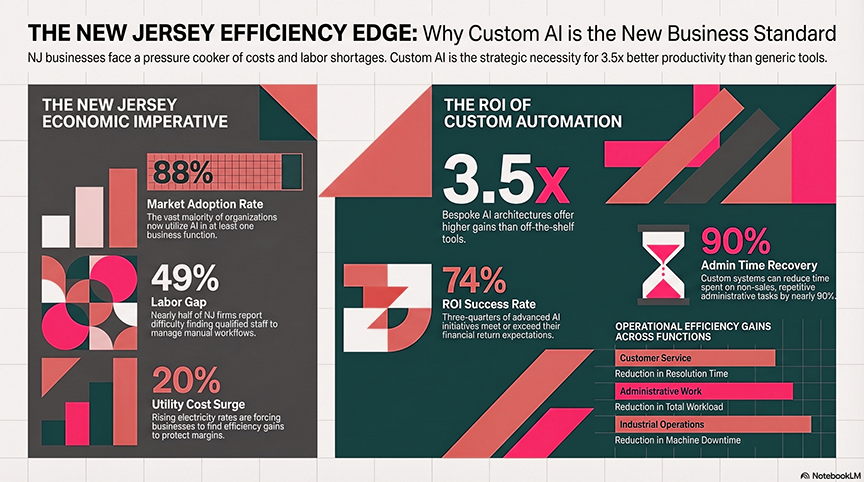
AI adoption in the United States has accelerated rapidly over the past two years, with over 50 percent of businesses now using some form of AI-driven automation. In the Northeast, including New Jersey, adoption is even more concentrated due to the region’s strong presence in finance, healthcare, logistics, and manufacturing.
New Jersey in particular has a unique business landscape:
- A dense network of mid-sized enterprises
- Strong pharmaceutical and healthcare sectors
- A logistics hub due to proximity to New York and major ports
- A growing professional services ecosystem
These industries are inherently process-heavy, making them ideal candidates for smart business automation.
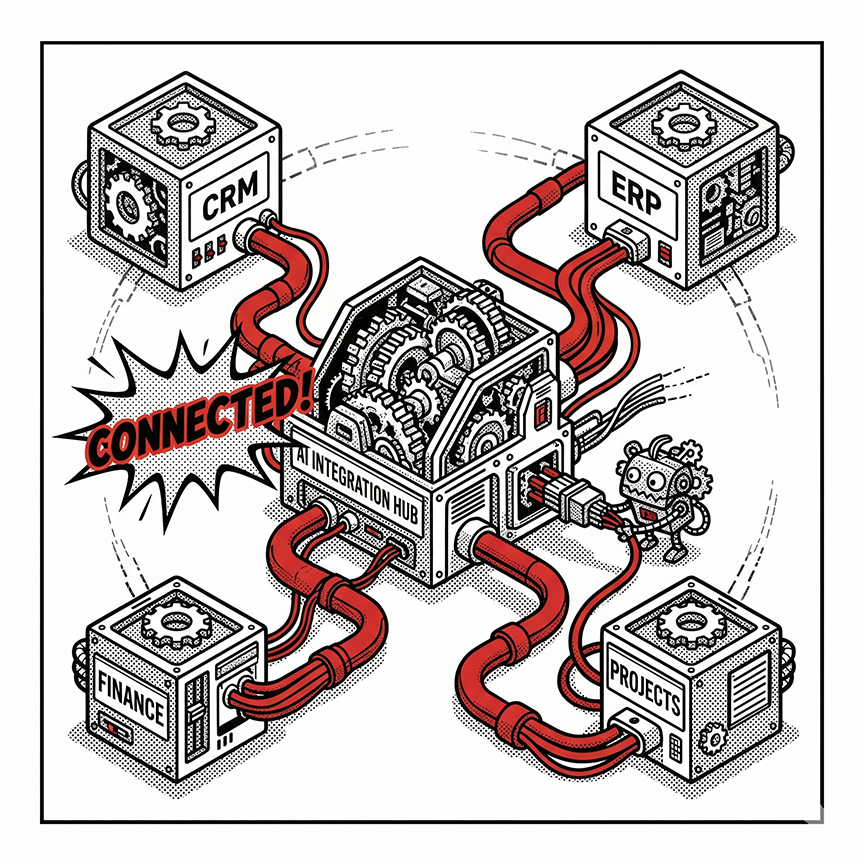
The challenge, however, is that many of these workflows are fragmented across systems, spreadsheets, emails, and legacy software. This fragmentation creates inefficiencies that standard tools cannot easily fix.
Custom AI solves this by integrating across systems and automating workflows end-to-end.
WHAT IS CUSTOM AI WORKFLOW AUTOMATION
Custom AI workflow automation refers to building AI-powered systems that are tailored to a specific business’s processes, rather than forcing the business to adapt to generic software.
These systems typically combine:
What does that actually mean for video?
You need:
- Machine learning models for prediction and decision-making
- Natural language processing for handling emails, documents, and queries
- API integrations to connect different platforms
- Automation logic to execute tasks without human intervention
Unlike traditional automation, which follows fixed rules, AI systems can learn, adapt, and improve over time.
This is particularly valuable in complex environments like construction, healthcare, or finance, where workflows are rarely linear.
KEY BUSINESS CHALLENGES AI SOLVES IN NEW JERSEY
1. MANUAL ADMINISTRATIVE OVERLOAD
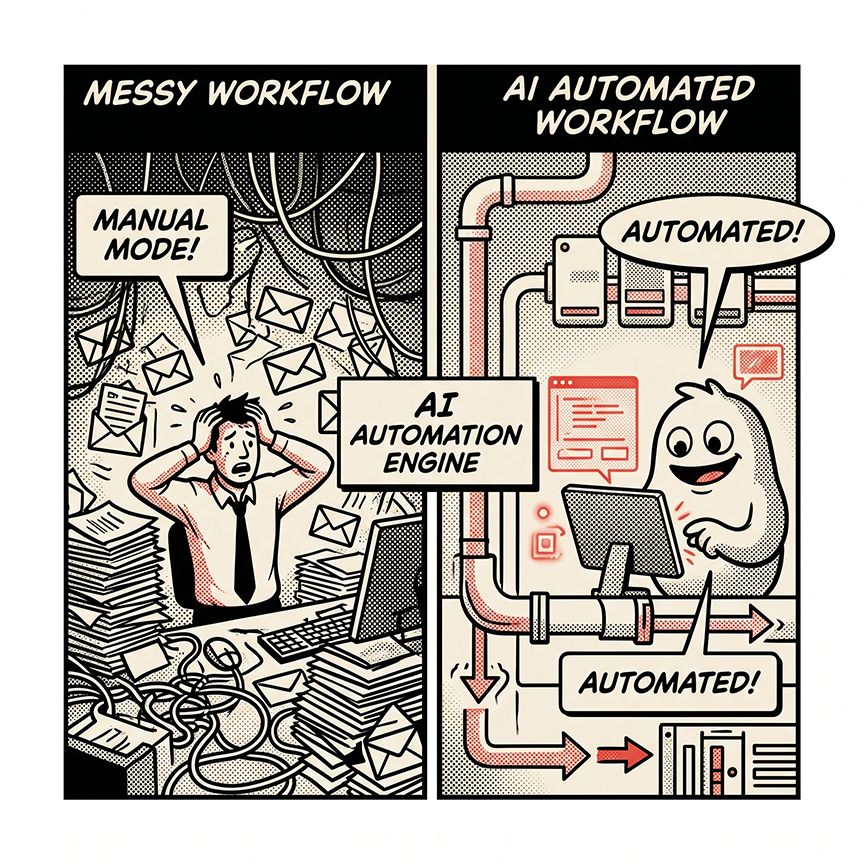
Many New Jersey businesses still rely heavily on manual processes such as data entry, report generation, and document handling.
AI can automate:
- Invoice processing
- Data extraction from forms and PDFs
- CRM updates
- Scheduling and email responses
This reduces administrative workload by up to 60 percent in some cases.
2. DISCONNECTED SYSTEMS
Businesses often operate with multiple systems that do not communicate effectively.
Custom AI can act as a bridge between:
- ERP systems
- CRMs
- Project management tools
- Financial software
This creates a unified workflow where information flows automatically, reducing errors and delays.
3. SLOW DECISION-MAKING
In industries like logistics and manufacturing, delays in decision-making can lead to significant losses.
AI enables:
- Real-time analytics
- Predictive forecasting
- Automated alerts and recommendations
This allows businesses to act faster and with greater confidence.
4. LABOUR SHORTAGES
New Jersey, like much of the US, is facing ongoing labour constraints.
AI helps by:
- Automating repetitive tasks
- Augmenting existing teams
- Allowing staff to focus on higher-value work
This is not about replacing people, but about increasing productivity per employee.
INDUSTRY USE CASES IN NEW JERSEY
CONSTRUCTION
Construction firms in New Jersey are using AI workflow automation to manage complex project pipelines.
Applications include:
- Automated project reporting
- Document management and compliance tracking
- AI-driven scheduling and resource allocation
This reduces delays and improves project visibility.
MANUFACTURING
Manufacturers are leveraging AI to streamline operations and reduce downtime.
Key use cases:
- Predictive maintenance
Supply chain - optimisation
- Quality control using computer vision
These systems help reduce waste and improve output consistency.
HEALTHCARE AND PHARMA
New Jersey’s strong healthcare sector is rapidly adopting AI.
Examples include:
- Patient data processing
- Appointment scheduling automation
- Clinical documentation support
AI reduces administrative burden on healthcare professionals, allowing more focus on patient care.
LOGISTICS AND DISTRIBUTION
With major ports and transport networks, logistics is a critical sector.
AI is used for:
- Route optimisation
- Demand forecasting
- Inventory management
This leads to faster deliveries and lower operational costs.
PROFESSIONAL SERVICES
Law firms, accountants, and consultants are adopting AI to improve efficiency.
Applications include:
- Document analysis
- Contract review
- Automated client onboarding
This allows firms to handle more clients without increasing headcount.
BENEFITS OF AI FOR BUSINESS EFFICIENCY
TIME SAVINGS
Businesses report significant reductions in time spent on repetitive tasks, often freeing up entire departments from manual processes.
COST REDUCTION
Automation reduces labour costs, minimises errors, and improves resource utilisation.
SCALABILITY
AI systems allow businesses to scale operations without a proportional increase in staffing.
IMPROVED ACCURACY
AI reduces human error in data handling, reporting, and compliance tasks.
BETTER CUSTOMER EXPERIENCE
Faster response times and more accurate information lead to improved client satisfaction.
HOW TO IMPLEMENT AI WORKFLOW AUTOMATION
STEP 1: IDENTIFY BOTTLENECKS
Start by analysing where time and resources are being wasted.
Common areas include:
- Manual data entry
- Repetitive communication tasks
- Reporting and analytics
STEP 2: DEFINE CLEAR OBJECTIVES
Determine what success looks like.
Examples:
- Reduce admin time by 40 percent
- Improve response time to clients
- Increase operational throughput
STEP 3: DESIGN CUSTOM SOLUTIONS
Work with an AI partner to design systems tailored to your workflows.
This includes:
- Mapping processes
- Identifying integration points
- Selecting appropriate AI models
STEP 4: IMPLEMENT AND TEST
Deploy the system in phases, ensuring it integrates smoothly with existing operations.
STEP 5: CONTINUOUS OPTIMISATION
AI systems improve over time with data and feedback. Ongoing optimisation is critical to maximise ROI.
THE FUTURE OF AI IN NEW JERSEY BUSINESSES
The adoption of AI workflow automation in New Jersey is only beginning.
Over the next five years, we can expect:
- Widespread integration of AI across all business functions
- Increased use of predictive and autonomous systems
- Greater emphasis on data-driven decision-making
Businesses that invest early in custom AI will have a significant advantage over competitors still relying on manual processes.
CONCLUSION
Custom AI is no longer a future concept. It is a practical, proven solution for improving business efficiency today.
For New Jersey businesses, the opportunity is clear:
Automate workflows, reduce operational friction, and unlock new levels of productivity.
The companies that act now will not only improve efficiency but position themselves for long- term growth in an increasingly AI-driven economy.
If you’re ready to explore how custom AI can transform your workflows, get in touch with our team to discuss the right solution for your business.
WHY OFF-THE-SHELF TOOLS ARE NOT ENOUGH
Many businesses start with generic automation tools but quickly encounter limitations:
- Lack of integration with existing systems
- Inability to handle complex workflows
- Limited customisation
- Poor scalability
Custom AI, on the other hand, is built around the business, ensuring:
- Seamless integration
- Flexibility to adapt as the business evolves
- Higher return on investment
This is particularly important in New Jersey, where businesses often operate in highly specialised environments.
Frequently Asked Questions (FAQs)
What is custom AI in business automation?
Custom AI refers to tailored artificial intelligence solutions built specifically for a company’s workflows, data, and goals. Unlike generic tools, it adapts to existing systems and processes to automate tasks, improve decision-making, and increase efficiency.
How does custom AI improve workflow automation?
Custom AI enhances workflow automation by handling repetitive tasks, making real-time decisions, and connecting multiple systems. It reduces manual effort, speeds up processes, and ensures smoother operations across departments.
Why should businesses invest in custom AI instead of ready-made tools?
Custom AI is designed around your unique business needs, offering better accuracy, deeper integration, and scalability. Unlike off-the-shelf tools, it evolves with your processes and delivers long-term efficiency gains.
What types of workflows can AI automate?
AI can automate a wide range of workflows, including:
- Customer support and chat responses
- Lead qualification and CRM updates
- Data entry and document processing
- Marketing automation and reporting
- Internal approvals and task management
These automations reduce workload and improve productivity.
How does AI reduce operational costs for businesses?
AI reduces costs by eliminating manual tasks, minimizing errors, and improving process speed. Businesses can handle more work without increasing staff, leading to better resource utilization and lower expenses.
Can small and mid-sized businesses benefit from custom AI?
Yes, AI is now more accessible than ever. Small and mid-sized businesses can use custom AI to automate daily operations, improve customer service, and compete with larger companies without massive investment.
How does AI improve decision-making in business workflows?
AI analyzes large amounts of data in real time to provide insights, predictions, and recommendations. This helps businesses make faster and more accurate decisions across operations, sales, and marketing.
What is the difference between traditional automation and AI automation?
Traditional automation follows fixed rules (if/then logic), while AI automation can understand context, process unstructured data, and make intelligent decisions. This makes AI far more flexible and powerful.
ABOUT THE AUTHOR
This article was created by the team at Motion Monsters, a US-focused agency specialising in AI-driven automation, motion design, and digital transformation.
Motion Monsters works with ambitious businesses to design and implement custom AI systems that streamline operations, automate workflows, and drive measurable efficiency gains. With a strong focus on real-world application and ROI, the team helps organisations move beyond generic tools and build intelligent systems tailored to how they actually operate.
If you are exploring how to automate business workflows with AI or improve efficiency across your organisation, Motion Monsters provides strategic guidance and hands-on implementation to make it happen.
