

AI-powered web design is reshaping how websites are built, optimized, and experienced in 2026. From automated layout generation to real-time personalization, AI tools are making websites smarter, faster, and more conversion-focused than anything traditional design methods could deliver alone. Businesses that adopt these trends now are pulling ahead of competitors still relying on static, manual-build websites.
AI graphic design is changing the rules of visual marketing in 2026. The challenge for most businesses is straightforward: low engagement, poor conversion rates, and the constant demand for fresh, on-brand visual content across every platform. Traditional design workflows — slow, expensive, and difficult to scale — are no longer keeping up.
AI changes the equation. With AI-powered design tools, businesses can produce professional-quality visuals faster, test what works in real time, and scale content production without scaling headcount. 88% of businesses now use AI design tools in some capacity, and the data shows why: visual content increases conversion rates by an average of 86%, and brands that invest consistently in visual content marketing are 13.7 times more likely to achieve positive ROI.
This guide covers how AI graphic design works, the tools driving it, and how combining smart creative strategy with AI automation delivers measurable results. Motion Monsters serves businesses across New Jersey and the wider NYC metro with exactly that — AI-powered design built around real commercial outcomes.
What Is AI Graphic Design?
AI graphic design is the use of machine learning, generative algorithms, and automation to create, optimize, and scale visual content. It moves design beyond manual, one-at-a-time asset production toward a data-driven, automated workflow where AI handles the repetitive and production-heavy work — freeing designers to focus on strategy, brand direction, and creative quality.
The difference from traditional design is fundamental. Traditional graphic design relies entirely on manual decisions: every layout, color choice, and format adaptation made individually. AI graphic design uses pattern recognition and performance data to generate, suggest, and test design options at a speed no manual process can match.
The industry has moved decisively in this direction. 64% of graphic designers view AI positively for ideation and 71% positively for routine tasks. 78% report that AI enhances their creativity — particularly at the concept and ideation stage.
How AI Enhances Graphic Design Workflows
AI improves every stage of the design workflow:
Faster creation: AI generates design options from a text prompt in seconds. What previously required hours of layout work is reduced to a prompt and a refinement pass.
Template generation: AI produces brand-consistent templates at scale across every required format — social posts, ads, banners, presentations — without starting from scratch each time.
Design suggestions: AI recommends color palettes, typography pairings, and layout adjustments based on what drives engagement for similar businesses and audiences.
Workflow automation: Resizing, reformatting, background removal, and file export run automatically. AI platforms increase multi-format delivery efficiency by 33% and reduce manual workload by 45%.
Top Creative Automation Tools Powering AI-Driven Design
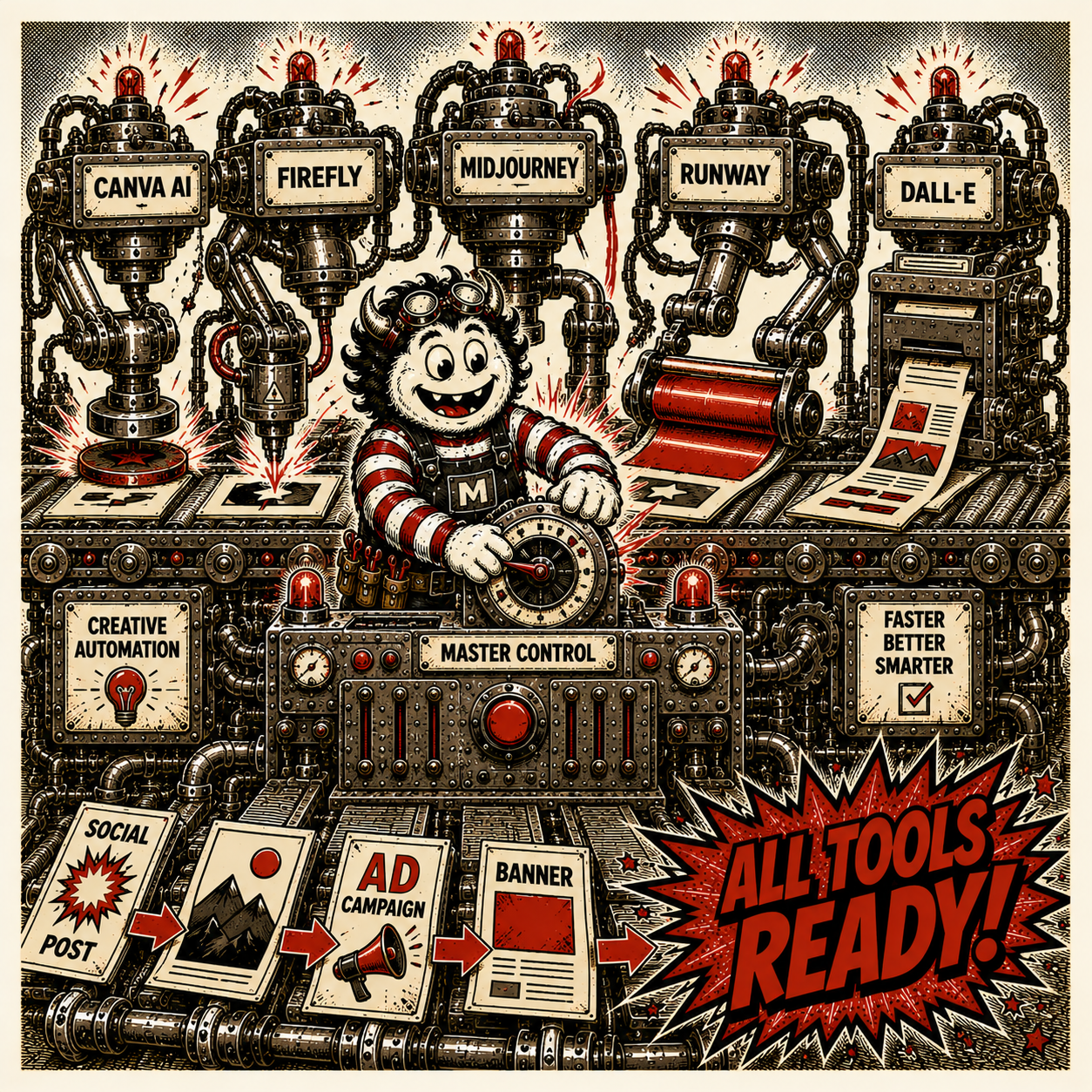
The shift toward smarter visual production is being driven by a new generation of creative automation tools — each solving a specific part of the design workflow.
Canva AI (Magic Studio)
Canva AI (Magic Studio) is the most accessible option for marketing teams and small businesses. With Magic Design, Magic Write, and AI image generation built in, Canva AI produces polished graphics from simple prompts. 95% of Canva Pro users actively use AI features. Pro plans start at $15/month.
Adobe Firefly
Adobe Firefly is the professional standard for commercially safe AI design. Integrated directly into Photoshop, Illustrator, and InDesign, Firefly handles Generative Fill, image expansion, text effects, and vector generation — all trained on licensed content with no copyright risk. Included in Creative Cloud; standalone plans from $9.99/month.
Midjourney
Midjourney remains the benchmark for visual ideation and concept-stage creative direction. Version 8 Alpha (March 2026) renders natively at 2K and runs five times faster than its predecessor. Best used for moodboarding, visual direction, and campaign concepting before moving to production tools.
Runway ML
Runway ML leads the market for AI video and motion content — text-to-video, image animation, and intelligent editing for social, brand, and marketing video production.
ChatGPT and DALL·E
ChatGPT and DALL·E combine text and image generation in unified workflows — practical for social ad creative, email headers, and rapid-iteration visual content where copy and image need to work together from the same prompt.
How Strategic Graphic Design Improves Engagement
Visual hierarchy directs the viewer’s eye to the most important elements first: the headline, the offer, the call-to-action. Businesses applying strategic visual hierarchy see 27% higher click-through rates than those running text-heavy, unstructured content.
Color psychology is one of the most powerful and most underused tools in marketing design. 85% of shoppers admit they are influenced by color in purchasing decisions. A single dominant brand color can triple memorability. Strategic graphic design applies color intentionally — not decoratively — to drive specific emotional responses and purchasing behavior.
Typography communicates brand personality and determines whether content is actually read. Strong typographic choices increase perceived professionalism, extend time on page, and improve comprehension — all of which feed downstream into engagement and conversion metrics.
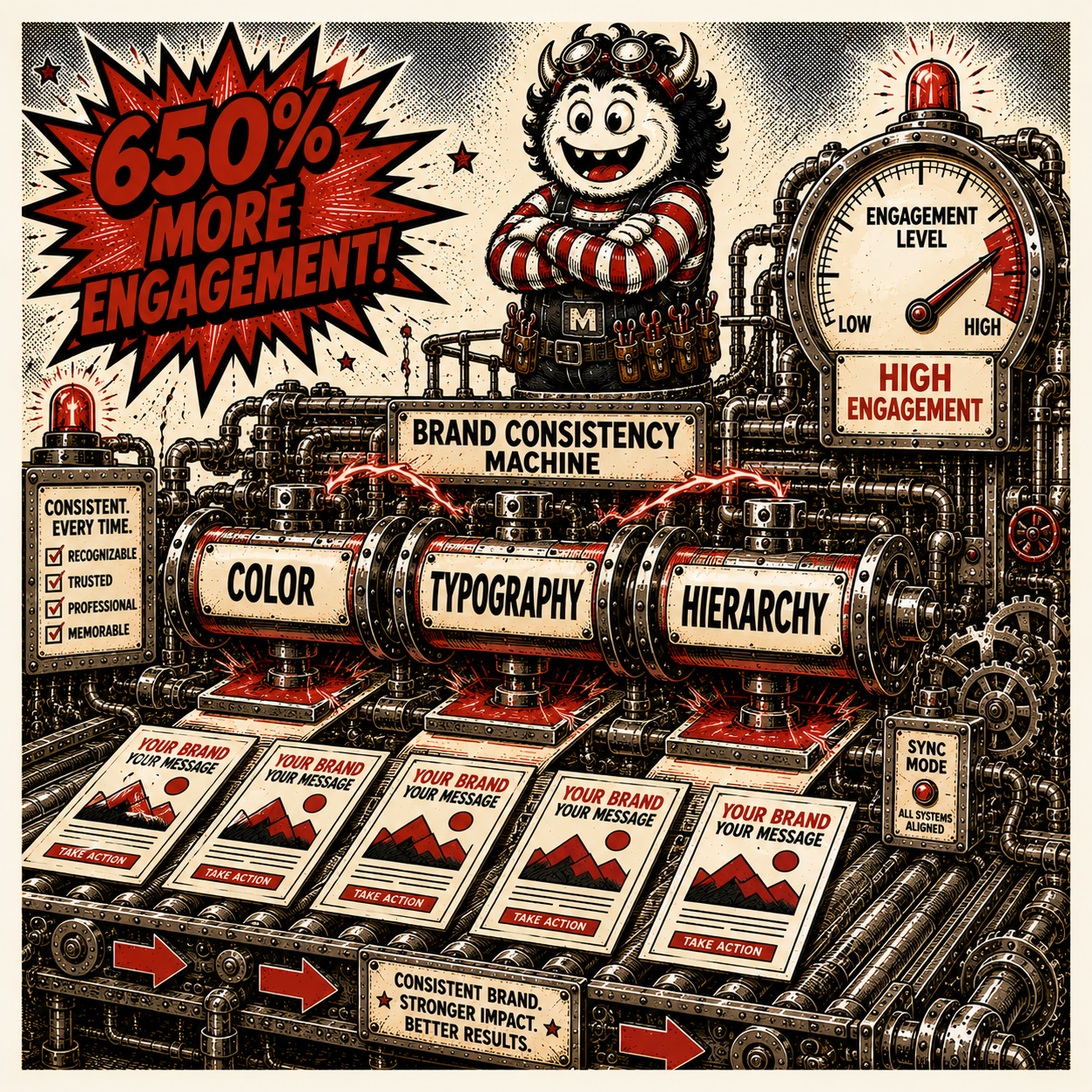
Brand consistency is where the commercial impact of design becomes most measurable. Posts with branded visuals get 650% more engagement than text-only posts. Consistent branding across all platforms can increase revenue by up to 23%. A 2026 Lucidpress study tracking 1,800 brands across 14 industries confirmed that companies maintaining strict brand consistency guidelines saw an average revenue uplift of 23.4%.
AI-Driven Graphic Design for Higher Conversions
Personalized visuals adapt to each audience segment. AI generates different visual treatments for different customer profiles — location, behavior, device, and intent all inform what a visitor sees. AI-based personalization improves conversions by 20–30%, and 48% of e-commerce brands using AI to optimize product photography have seen conversion rate increases of 12%.
A/B testing at scale is one of AI’s most powerful design applications. AI runs simultaneous multivariate tests across layout variants, hero images, CTA button styles, and color combinations — identifying the highest-performing combination and automatically serving it to the majority of visitors. 74% of UX and UI designers use AI for data-driven design decisions.
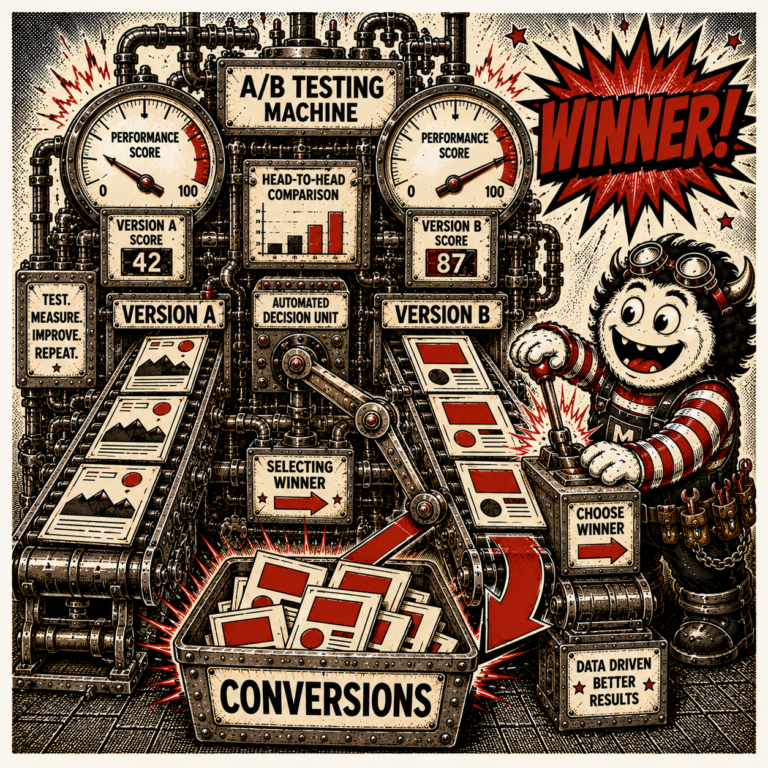
Data-based design decisions replace intuition with evidence. AI analyzes engagement patterns, scroll depth, click maps, and session recordings to identify exactly which visual elements drive action — and which ones create friction. Data-driven design decisions consistently produce 2–3 times higher conversion rates than decisions made by gut instinct alone.
Optimized CTAs are one of the highest-ROI applications of AI in design. Color, size, copy, placement, and contrast are all tested across multiple audience segments simultaneously — delivering the best-performing CTA automatically to the right visitor.
Key Benefits of AI in Graphic Design
AI in graphic design delivers measurable advantages across every dimension of creative production:
Faster production: AI templates increase productivity by 40% and reduce development cycles by up to 70%. Multi-format delivery efficiency improves by 33%.
Cost efficiency: AI tools handle repetitive production tasks that previously required hours of billed designer time — resizing, reformatting, variant creation — at a fraction of the cost.
Better consistency: AI enforces brand guidelines at scale — same fonts, colors, and spacing across every asset, every platform, every campaign.
Improved performance: Manual workload reduction of 45% frees designers to focus on high-value strategic and creative work. Businesses investing in visual content are 63% more likely to achieve positive ROI.
Why Motion Monsters Leads in AI Graphic Design Solutions
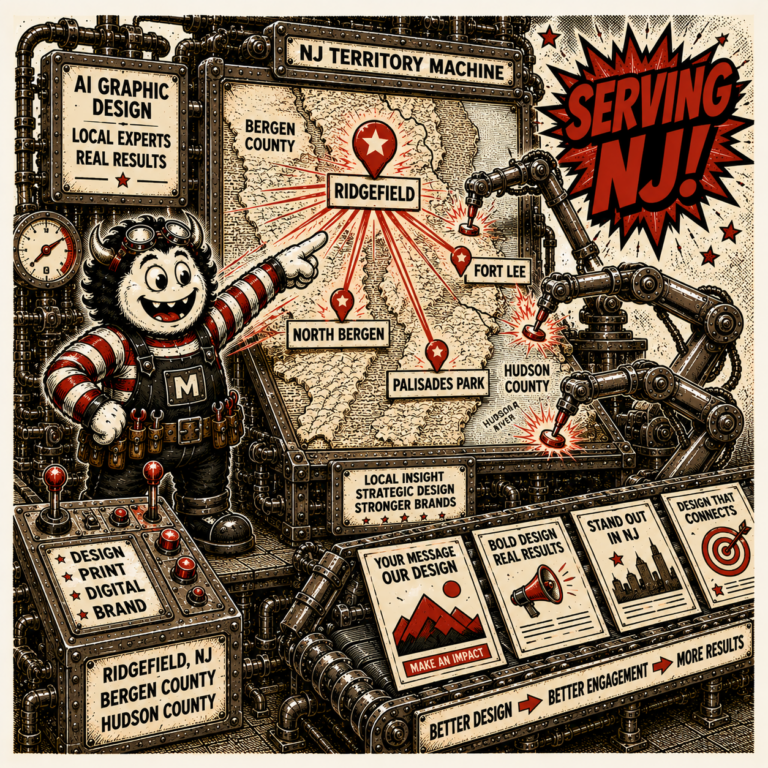
For businesses in Ridgefield, Fort Lee, Palisades Park, Cliffside Park, North Bergen, and across Bergen County and Hudson County, the competitive standard for creative work is set by Manhattan agencies just across the river. Matching — and beating — that standard requires design that combines strategic thinking with AI-powered production capability.
Motion Monsters at 1116 Edgewater Ave, Ridgefield, NJ brings both. Custom AI-powered design services cover everything from full branding and marketing creatives to conversion-focused web visuals, social content, and motion graphics. Every project is built around scalable systems: AI tools that maintain brand consistency across campaigns at scale, with human creative strategy ensuring every output is tied to a measurable business outcome.
Supported by sister companies Designwest and Vertical Creatives, the Motion Monsters team delivers best-in-class design, branding, digital, and video solutions across New Jersey and beyond.
Ready to make your design work harder? Request a Consultation with Motion Monsters today at motionmonsters.com.
Key Takeaways
AI graphic design uses machine learning and generative tools to produce, test, and optimize visual content faster and at lower cost than traditional design workflows.
88% of businesses now use AI design tools; visual content increases conversion rates by an average of 86%.
The leading creative automation tools in 2026 are Canva AI, Adobe Firefly, Midjourney, Runway ML, and ChatGPT/DALL·E — each serving a different part of the design workflow.
Strategic graphic design principles — visual hierarchy, color psychology, brand consistency — amplify the results AI tools produce.
Consistent branding across platforms delivers up to 23% revenue increase; brands investing in visual content are 13.7x more likely to achieve positive ROI.
Frequently Asked Questions
1. What is AI graphic design?
AI graphic design uses machine learning and generative AI to create, optimize, and scale visual content. Tools like Canva AI, Adobe Firefly, and Midjourney generate layouts, suggest color palettes, produce image assets, and automate repetitive production tasks — delivering professional-quality output faster and at lower cost than manual design alone.
2. How does AI improve graphic design?
AI reduces manual workload by 45%, increases multi-format delivery efficiency by 33%, and accelerates development and prototyping cycles by up to 70%. It also enables data-driven design decisions — testing color, layout, and CTA variations against real engagement data — so every design choice is backed by performance metrics.
3. What are the best AI graphic design tools in 2026?
The leading tools are Canva AI for accessible everyday marketing design, Adobe Firefly for commercially safe professional creative work, Midjourney for visual ideation and creative direction, Runway ML for AI video and motion content, and ChatGPT/DALL·E for rapid integrated text and image workflows.
4. How much do AI graphic design tools cost?
Canva Pro starts at $15/month. Midjourney ranges from $10–$120/month. Adobe Firefly standalone plans start from $9.99/month; Creative Cloud starts at $54.99/month. For most small businesses, $15–$20/month covers the core toolkit needed for professional-quality output.
5. How much time does AI save in graphic design?
AI templates increase productivity by 40% and reduce manual workload by 45%. McKinsey data shows generative AI can reduce development and prototyping cycles by up to 70% when properly embedded in workflows. Automated color palette tools alone reduce design time by 20%.
6. Does AI graphic design work for social media?
Yes. AI excels at social media production — generating multiple format variants from a single brief, maintaining brand consistency, and testing which visuals drive the most engagement. 60% of US companies already use generative AI to maintain always-on social media presence.
7. Can AI replace graphic designers?
18% say it has reduced their need for designers. Strategic, brand-level, and performance-driven creative work still requires human expertise. AI handles production; designers lead creative direction and strategic output.
8. How does AI improve conversion rates through design?
Visual content increases conversion rates by an average of 86%. AI amplifies this by personalizing visuals per audience segment, running continuous A/B tests, optimizing CTAs, and making data-driven layout decisions automatically — improving results without ongoing manual intervention.
9. What is the ROI of AI graphic design?
Brands consistently investing in visual content are 13.7x more likely to achieve positive ROI. Consistent branding delivers up to 23% revenue increase. Businesses earn $5 for every $1 spent on digital marketing — design drives that return through improved CTR and conversion rates.
10. How does brand consistency impact marketing performance?
Posts with branded visuals get 650% more engagement than text-only. Consistent branding across all platforms can increase revenue by up to 23%. A 2026 Lucidpress study confirmed that companies with strict brand consistency guidelines saw an average 23.4% revenue uplift across 1,800 global brands.
11. What is strategic graphic design?
Strategic graphic design applies visual hierarchy, color psychology, typography, and brand consistency to serve a specific business goal. It produces measurable outcomes: higher engagement, lower bounce rates, stronger conversions, and increased brand recall — not just visually polished work.
12. How does color psychology affect conversions?
85% of shoppers are influenced by color in purchasing decisions. A single dominant brand color can triple memorability. Strategic use of color — green for wellness, red for urgency, black for premium positioning — directly impacts how visitors feel and what actions they take on a page.
13. What is creative automation in graphic design?
Creative automation uses AI to generate, resize, reformat, and distribute visual assets automatically. Rather than producing individual assets for each platform and format manually, AI takes a master design and produces all required variants — maintaining quality and consistency across every output.
14. How does AI help with A/B testing in design?
AI runs simultaneous multivariate tests across design variants — testing button colors, hero images, headline styles, and CTA placements at the same time. It identifies the highest-performing combination and automatically serves it to the majority of visitors, improving conversions without manual test management.
15. Is AI-generated design good enough for professional marketing?
Yes, when guided by human creative strategy. 78% of graphic designers report AI enhances their creativity. 82% of design professionals are excited about AI collaboration. The key is using AI for production speed and scale while retaining human oversight for brand voice, strategic direction, and quality.
16. How does AI graphic design support social media engagement?
AI generates multiple visual variants optimized per platform, tests which formats drive the most engagement, and maintains brand consistency. Branded posts receive 650% more engagement than text-only content. AI makes this volume of consistent, tested output achievable for businesses of any size.
17. What role does visual hierarchy play in engagement?
Visual hierarchy guides the viewer’s eye from the most important element — the offer or headline — to supporting content and CTA. Marketers applying strong visual content strategies see 27% higher click-through rates than those using primarily text-based approaches.
18. How does AI graphic design help NJ businesses compete?
Bergen County businesses compete directly with Manhattan agencies for clients and creative work. AI graphic design gives NJ businesses — in Ridgefield, Fort Lee, Palisades Park, North Bergen, and across the metro — the production capability to match NYC-agency output quality at a fraction of the cost, while backing every design decision with real performance data.
19. What types of businesses benefit most from AI graphic design?
Every business producing marketing materials, running social media, or using visual content in advertising benefits. Highest-impact use cases: e-commerce (product photography, ad creative), professional services (branding, presentations), healthcare (patient-facing content), real estate (property marketing), and retail (promotional and seasonal content).
20. How can Motion Monsters help with AI graphic design in New Jersey?
Motion Monsters at 1116 Edgewater Ave, Ridgefield, NJ combines AI-powered design tools with over 30 years of professional creative expertise. Serving businesses across Bergen County, Hudson County, and the broader NJ/NYC metro — including Fort Lee, Palisades Park, Cliffside Park, and North Bergen — Motion Monsters delivers custom AI graphic design, branding, marketing creatives, and conversion-focused visuals built around measurable business results. Request a Consultation at motionmonsters.com/graphic-design-nj/.
The result is a website that performs — generating leads, driving calls, and supporting business growth for companies across New Jersey, from Bergen County to Hudson County and throughout the NJ/NYC metro area.
Ready to build a smarter website? Request a Consultation with Motion Monsters today.
Declan Foley is an Irish Creative Director with over 30 years of experience in design, motion, and visual storytelling. As Creative Director of Motion Monsters, he leads high-end video, motion graphics, drone production, and AI-integrated creative workflows for businesses across New Jersey and beyond. Explore what Motion Monsters can do for your business at motionmonsters.com.
